November 12, 2026

6
min read
What Is Your Video Library Worth for AI Training?
AI companies license video by the hour. See what your library could earn, which footage pays most, and how licensing for AI training works.
AI companies license video by the hour. See what your library could earn, which footage pays most, and how licensing for AI training works.
Short answer: AI developers license video for training by the hour and by the clip. What your library is worth comes down to three things: how many hours you control, where the files live, and how hard the footage is to find elsewhere. You can get an indicative estimate for your own library in under a minute with the free Versos Content Value Assessment.
That's the summary. The rest of this post explains how the market prices footage, since most library owners we talk to have never been told.
Yes. Video generation models, robotics systems and multimodal models all need large amounts of licensed footage, and the labs building them now buy it directly from rights holders. They buy in volume, usually by the hour or by the clip, and against detailed specs for resolution, length, camera movement, subject matter and rights.
The catch for sellers is that most of this is private. There's no rate card. Deals are confidential, and a buyer has no reason to tell you your footage is worth more than they're offering. That gap is why we built a calculator.
Public deal signals put quality licensed video at roughly $1 to $4 per minute, with premiums for 4K, drone and exclusive footage, according to the Versos AI Training Data Demand Tracker. That's a wide range, and where your library lands depends on what's actually in it.
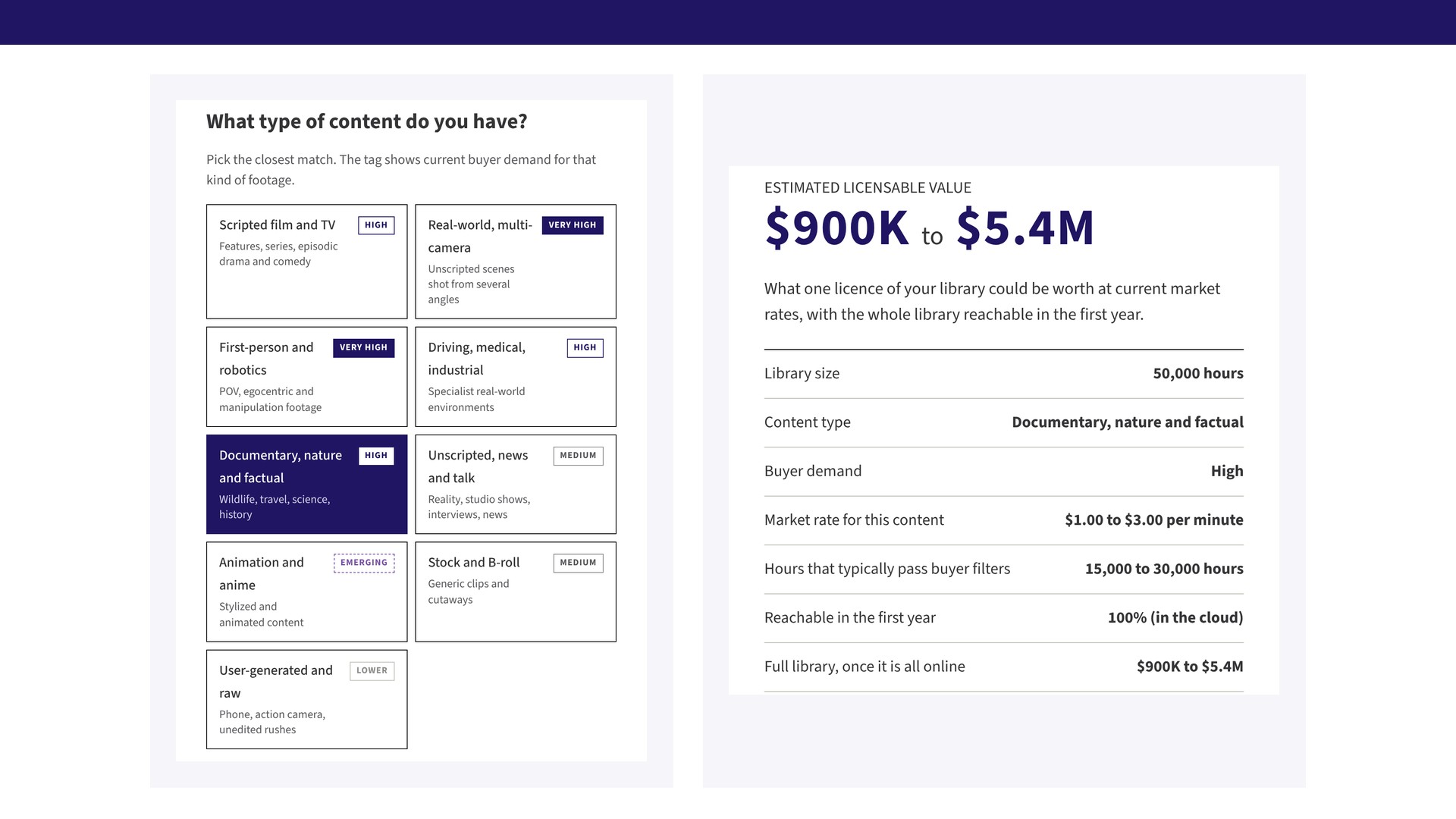
The Content Value Assessment narrows it down with three questions:
It then shows you:
Pay attention to the filter number. Buyers reject most footage in most libraries because it doesn't meet their technical or content specs. A 100,000-hour archive and a 20,000-hour archive can earn similar amounts if the smaller one is cleaner and more specific. Total hours tell you how big a library is. Hours that pass filters tell you what it can earn.
Three factors do most of the work.
Volume. Labs want to fill large orders from as few sources as possible. Our estimates start at 10,000 hours, which is about where a single library can answer the biggest requests without being combined with others.
Accessibility. Footage in S3, Google Cloud, Azure or Cloudflare can be connected read-only and assessed where it sits. Footage on drives or LTO tape has to be digitized or moved online before anyone can evaluate it. It still has value, but less of it is reachable in the first year.
Scarcity. Buyers pay for what their models can't get anywhere else. Generic stock footage is getting cheaper because so much of it exists. Scarce footage is moving the other way.
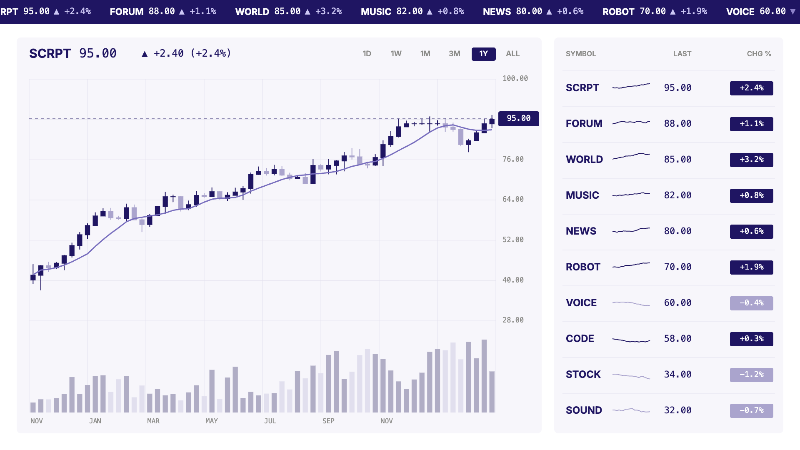
The Demand Tracker scores each video category on capability heat, scarcity and proven spend. As of 9 November 2026, the ranking looks like this:
Multi-camera footage, where the same moment is captured from several angles at once, also commands a premium. Demand shifts quickly, so check the live tracker for the current picture.
Usually, yes. Most AI training deals are non-exclusive, so the same hours can be licensed to several buyers with different requirements. Our estimate values one non-exclusive licence on purpose. It's meant as a floor. If you license the footage more than once, you earn more than the estimate shows.
With Versos, it takes three steps.
Comparing your options first? See our roundup of the top places to sell video content for AI training.
Versos is a data exchange. We're the infrastructure the deal runs on. We don't take ownership of your content or resell it.
Public signals put quality licensed video at roughly $1 to $4 per minute, with premiums for 4K, drone and exclusive footage. Scripted, real-world and first-person footage sit at the top of current demand. Most contracts are private, so treat public figures as directional.
No. It's an indicative range based on current market rates. Final value depends on your rights, technical quality, buyer requirements and what a full assessment finds.
The estimator starts at 10,000 hours. Smaller libraries can still be licensed, but they're usually combined with other sources to fill large orders.
No. It takes under a minute and doesn't ask for an email.
Yes. It just takes longer to reach. Once it's digitized and online it can be assessed and licensed like any cloud library, so the estimator gives you separate year-one and full-library numbers.
No. Versos connects read-only to your existing storage and analyzes the footage in place.
Your archive already earned its money once. AI training is a second market for the same footage, and it pays most for exactly the kind of material that's hard to find.
Get your free estimate in under a minute. No sign-up required.
Whether you’re a studio looking to monetize your archive or an AI team searching for structured, licensed training data, we’re here to help.